


Technological advancements in tractor manufacturing are reaching new heights. Today we are talking about a pilot project bringing humanoid robots to the assembly lines of major agricultural brands. Let's see what is happening in the United States and what lessons we can learn for the daily maintenance of our equipment.
Humanoid robots in AGCO factories from 2027
The AGCO Group, a world leader in the design and manufacture of agricultural machinery, has announced a major step toward advanced automation in its facilities. In 2027, a pilot project involving humanoid robots on production lines will kick off at the Hesston plant in Kansas (USA).
The news was released directly by AGCO following a commercial agreement with Agility Robotics, an American company specializing in humanoid robotics and manufacturing technology. The primary goal of this partnership is to make production sites increasingly flexible, smart, and efficient without having to overhaul or rebuild existing facility structures from scratch.
The main player on the floor will be the humanoid robot named Digit®. Initially, this tech assistant will handle key operations within assembly and production departments. Specifically, it will take care of component selection, sorting and stacking parts, as well as the orderly and smart placement of storage bins across various departments.
What makes these devices unique is their ability to adapt. Thanks to advanced systems and integrated platform management over networks, the robot continuously learns from shifts in work paces and flows, allowing the company to introduce automation gradually. With this project, AGCO joins other major international industrial groups, such as Toyota, GXO, and Schaeffler, which have already begun testing these technologies on their assembly lines.
In short
- Where and when. The pilot project will launch in 2027 at AGCO's Hesston plant in Kansas (USA).
- The partnership. The agreement was signed with Agility Robotics to bring humanoid robotics into agricultural factories.
- The Digit® robot. It will perform part selection, stacking, and storage container handling tasks.
- Rapid adaptation. The system learns from workflows without requiring expensive modifications to production facilities.
- Global partners. AGCO joins other major industrial companies like Toyota, GXO, and Schaeffler in adopting these technologies.
The introduction of such advanced tools marks a turning point in how future tractors will be built and assembled, proving that industrial precision is reaching unprecedented levels.
What robotics teaches us about maintenance in the field
At first glance, the arrival of humanoid robots in a large factory in Kansas might seem far removed from daily work among the olive groves of Calabria or in wheat fields. However, this news points to a very clear direction: modern agricultural machinery is and will be built with increasingly tight precision and mechanical tolerances.
When tractors and implements are assembled with components controlled to the millimeter by automated systems, the owner's or operator's work must adapt as well. A modern tractor comes from a meticulous manufacturing process and requires equally careful maintenance throughout its service life to keep its reliability intact.
For those working in the fields every day, this means changing their approach compared to the past. It is no longer enough to react only when a part breaks or a dashboard warning light comes on. You need to prevent wear, use spare parts that perfectly match manufacturer specifications, and keep your home workshop organized to work cleanly and safely.
Technology advances to assist people, not to replace the experience of those who farm the land. But to get the most out of such sophisticated machinery, preventive maintenance and choosing the right products are essential tools to prevent prolonged downtime and unexpected expenses.
5 steps for precise, trouble-free maintenance
-
Organize your workspace and tools
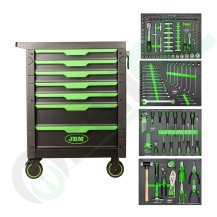
Precision starts with order. Working in a clean, well-organized workshop reduces the risk of losing bolts, contaminating oils with dust, or installing a replacement part incorrectly. Using a drawer tool trolley keeps your wrenches, sockets, and pliers right where they belong during repairs.
-
Use engine-specific lubricants and oils
New-generation agricultural engines require high-performance oils to protect internal mechanical components from friction and high temperatures. Always check the required viscosity and specifications before changing the oil, and avoid mixing products with different properties.
-
Regularly check exhaust and gas recirculation systems
Components related to emissions management, such as exhaust gas recirculation (EGR) valves, are sensitive to sludge and carbon deposit buildup. Timely cleaning or replacing these parts ensures correct engine power and prevents abnormal fuel consumption.
-
Keep your lighting system efficient
Working in the field often means starting before dawn or continuing late into the evening. Checking the condition of headlights, reflectors, and protective bezels ensures visibility and helps avoid fines during road transport with agricultural vehicles.
-
Check the condition of grease pumps and lubrication systems
Lubricating pivot points, top links, and implements attached to the tractor is essential to prevent premature wear. Replacing worn membranes in grease pumps helps maintain correct grease pressure without damaging leaks.

Before taking apart a component from your tractor or farm machinery, snap a clear photo of the data plate or the worn part. Having exact part numbers on hand helps identify the precise replacement immediately and prevents purchasing errors.
If you have any doubts about the correct spare part for your tractor, send us a photo of the part or data plate on WhatsApp or stop by to visit us in Crotone. The Raim team will help you find the right solution with fast GLS shipping throughout Italy.